
Guide
How to track competitor mentions on Reddit
Updated 31 August 2026
The short answer
Track each competitor's name and its spellings in the subreddits your shared customers use, then sort what comes back by what the thread is doing: choosing, complaining, or simply mentioning. The threads worth answering are the ones where somebody is deciding, and those are more often about a competitor than about you.
Redwatcher is a Reddit monitoring tool that scores every keyword match for relevance before it alerts you. Each competitor counts as one keyword. From $29 a month, seven-day trial, no card.
Which competitors to track
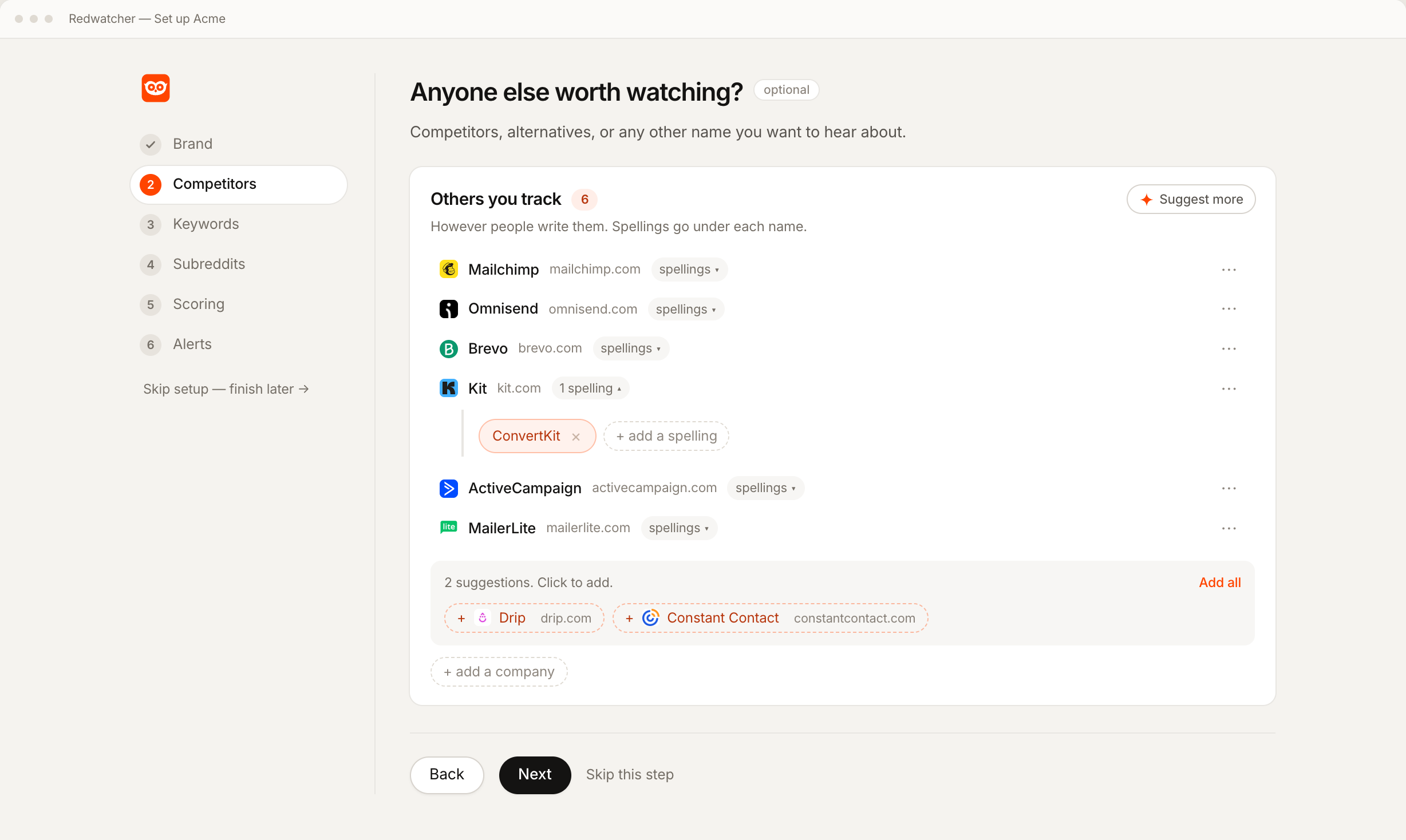
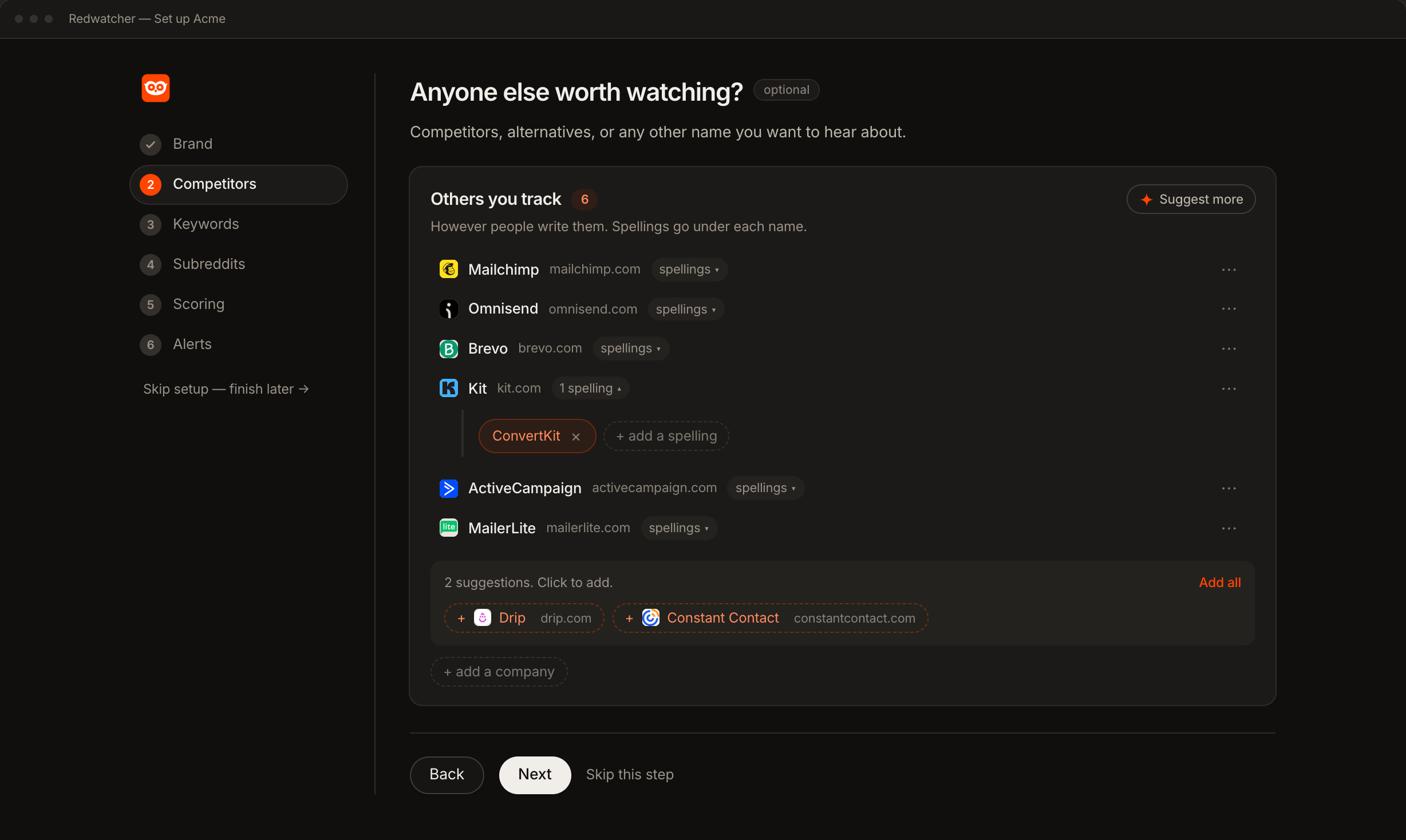
Not all of them. Three groups earn their keyword:
- The tool you lose to. Whoever comes up when a prospect says they are considering something else.
- The tool people are leaving. After a price rise, a shutdown or a bad release, a competitor's name starts appearing in posts from people looking for a replacement.
- The default. The option most people try first. Its limits are usually why anyone starts looking.
Spellings matter here as much as for your own brand: the product written lower case, without its space, or with the company name instead.
What the threads are actually worth
Competitor tracking gets useful once you sort what comes back by what the thread is doing.
| The thread is… | Worth your time |
|---|---|
| Choosing between named products | Yes — the decision is open |
| Asking for an alternative to a competitor | Yes — the need is explicit |
| Complaining about a competitor | Sometimes — answer the problem, not the brand |
| Praising a competitor | Rarely |
| Selling or listing one second-hand | No |
| Hiring for one | No |
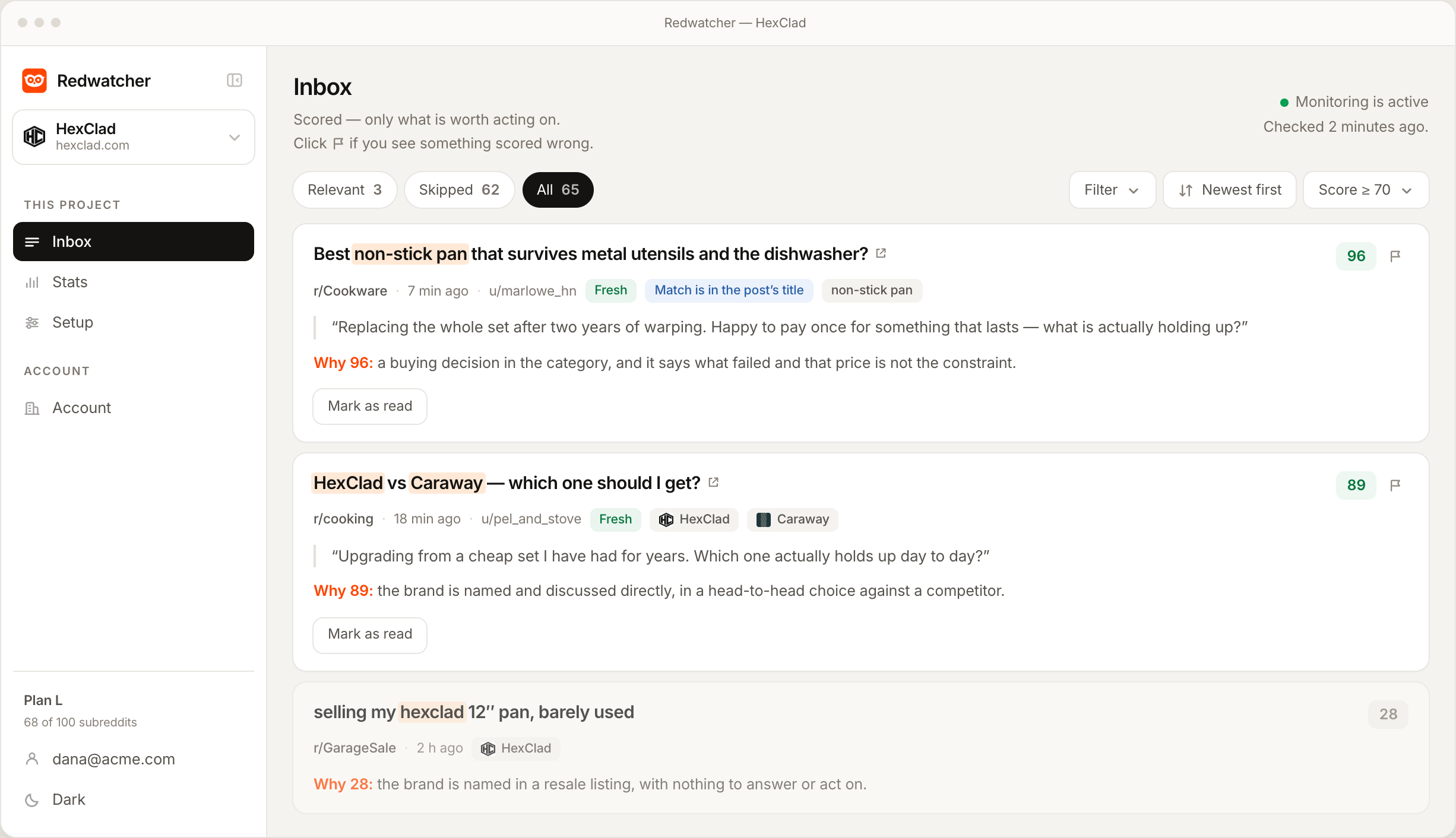
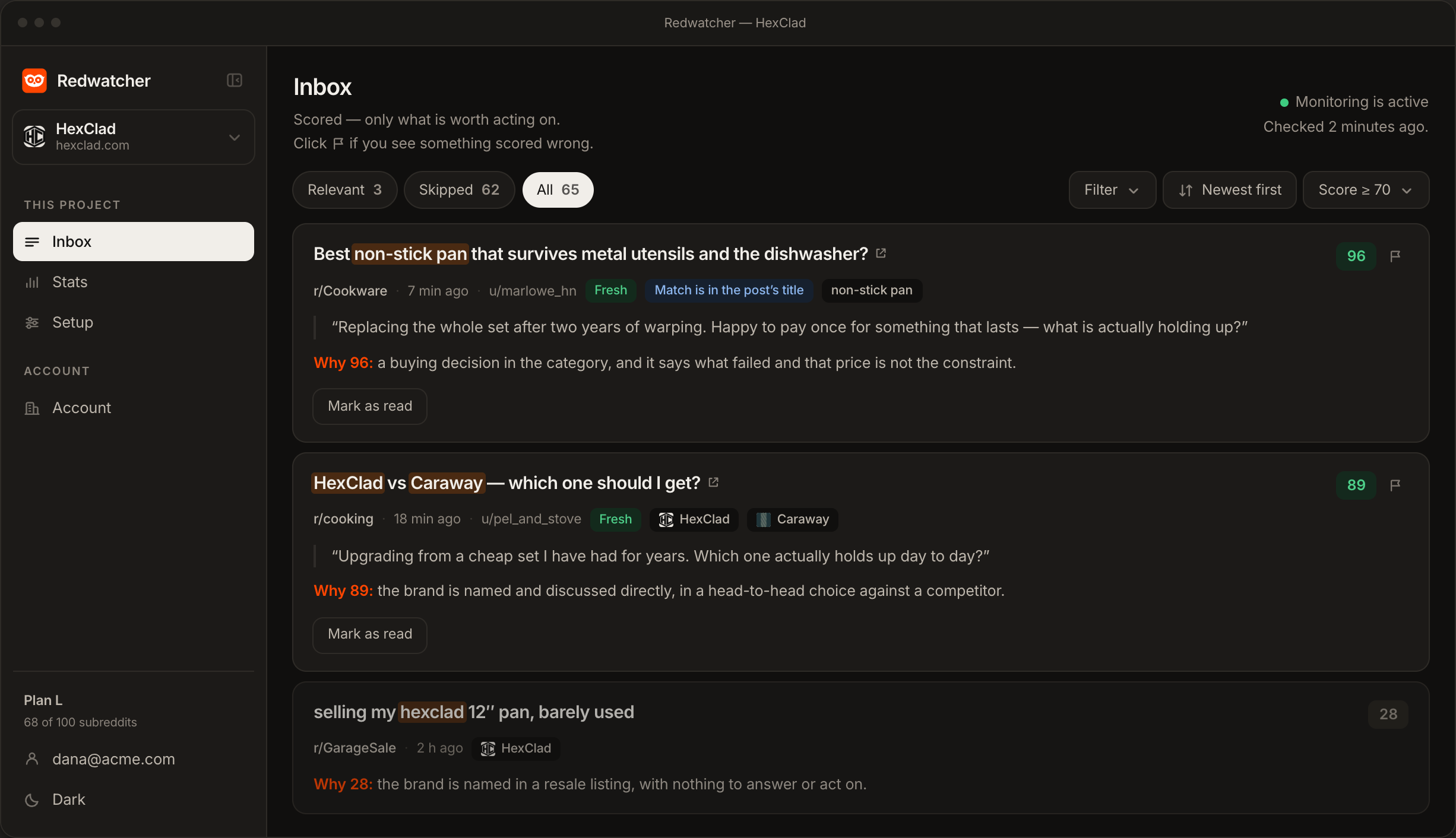
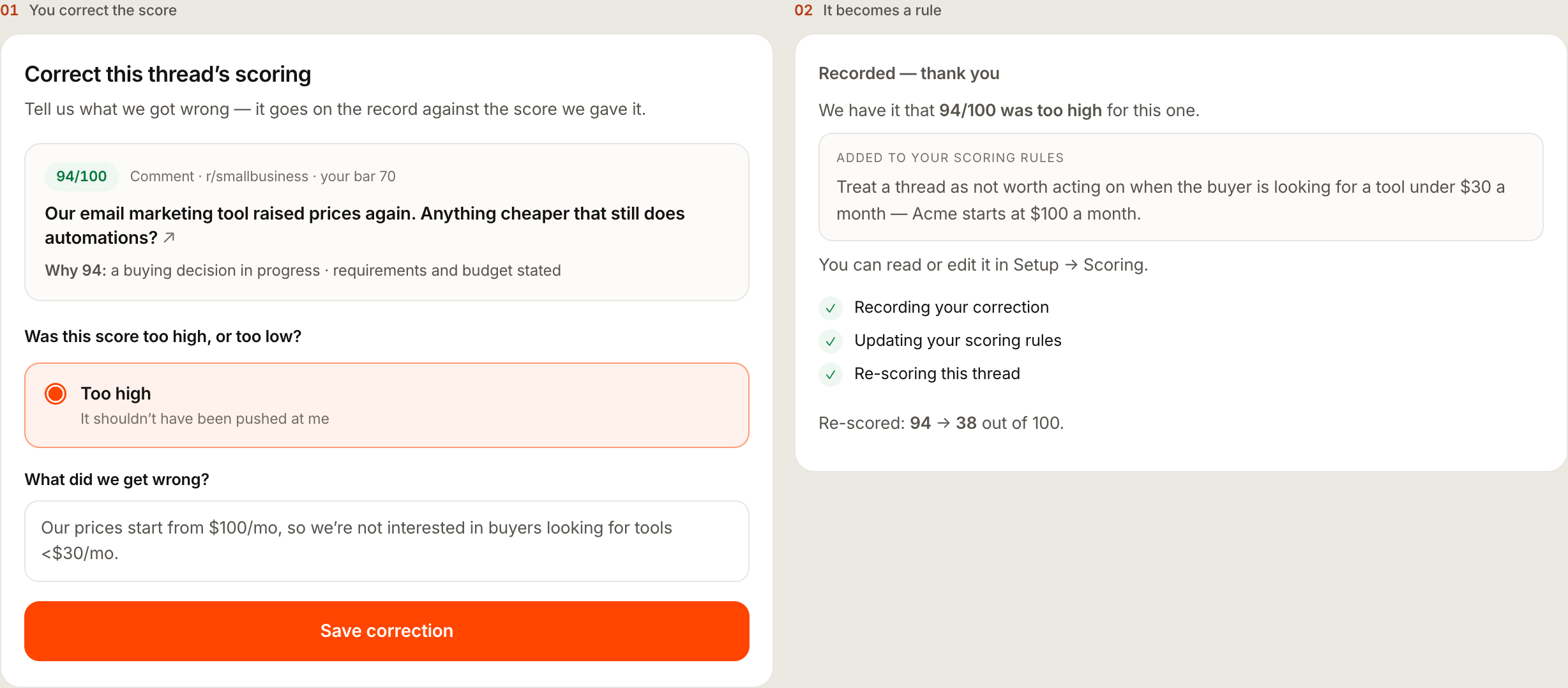
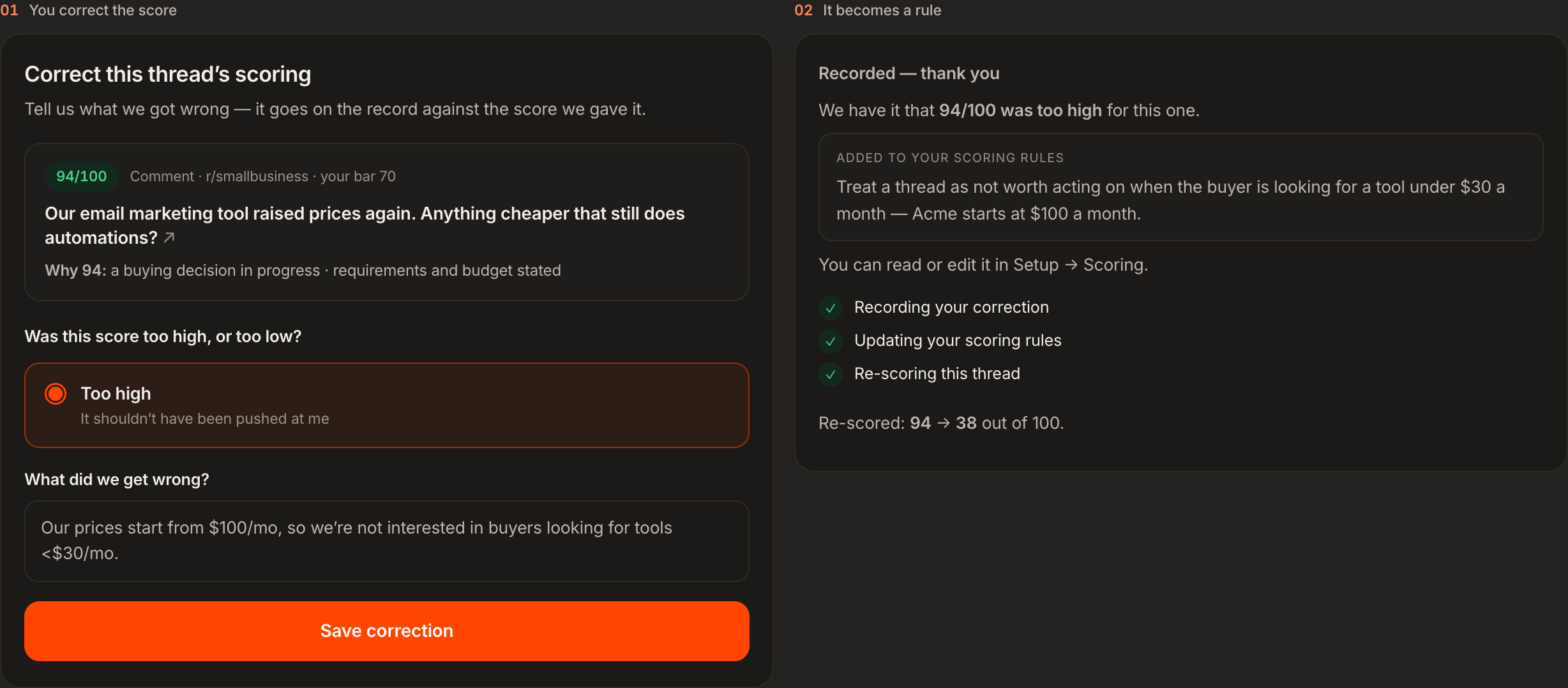
Scoring does this sorting for you once you have told it what matters. Redwatcher's rules are written in plain language, and correcting a score once writes the rule that applies to every later thread.
What to track besides the name
Their name is the obvious term to add, and on its own it is the least specific one you can track. Four others bring back better threads.
"alternative to X" and its variants. This is the highest-intent phrase in the category: the person has already decided to leave and is asking where to go.
The complaint that is yours to answer. Every product has a recurring one, and it is usually about a limit rather than a bug: a cap, a missing integration, a price step. That phrase alongside the competitor's name finds people at the moment the limit hurt them.
Migration language. Moving from, switching off, exporting from. These threads are about process. Answer the process question and you are welcome there. Pitch, and you are not.
Their pricing terms. A price rise or a plan change produces a burst of threads for a week or two, and those threads are full of people comparing options in public.
How to use what you find
Competitor threads are worth more than the reply you write in them.
Product. A complaint that appears three times in a month is a roadmap item with evidence attached, and it comes with the language customers use for it.
Sales and marketing. The words in these threads are the words to use on your own pages. It is the difference between a comparison page that answers what people are asking and one written off a feature matrix.
Positioning. If the same competitor keeps winning on the same point, you want to know early. What you then do about it is your call, but you should be making it deliberately.
How to be in the thread without being removed
Replying in a thread about a competitor carries more risk than any other reply. Four rules cover most of it.
- Say who you are. Hiding the affiliation is what gets comments removed and accounts banned, and readers spot it long before a moderator does.
- Answer the question that was asked, including when the honest answer is that your product does not do it.
- Do not lead with a link. A useful comment that happens to mention what you build is received very differently from a pitch with a URL at the top.
- Never post from a fresh account with nothing else on it. That pattern is exactly what moderators look for.
Redwatcher does not draft or post replies. It finds the thread, scores it, explains the score and links you to it, and you write the reply yourself. A tool that suggests the reply and sends direct messages for you is a different product, and the Redreach alternative page sets one beside Redwatcher.
RedwatcherReddit monitoring, every match scored
 Redwatcher
Start free Seven days, no card. From $29 a month after. See how the tracking works
Tracking competitors on Reddit: questions people ask
How do I monitor my competitors on Reddit?
Add each competitor as a term, name the subreddits your shared customers use, and score what comes back so the threads where a choice is being made reach you and the resale listings do not.
How many competitors should I track?
Three to six is usually enough to cover a category, and it leaves room in a 25-keyword plan for your own brand, its spellings and the problem phrases that find threads before anyone names a product.
Does tracking competitors cost extra?
No. Every competitor you track counts as one keyword against the plan you already have: 25 keywords at $29, 50 at $49 and 100 at $89. There is no separate charge for competitor tracking.
Can I see when someone asks for an alternative to a competitor?
Yes, though it is the scoring that does it rather than the keyword. A competitor's name turns up in thousands of threads and only a small share of them are asking for a replacement, so the two have to be told apart on context, not on the word itself.
Is it against Reddit's rules to reply in a competitor's thread?
Replying is allowed. The rules on self-promotion are set by each community and enforced by its moderators, so disclose who you are, answer the question, and do not lead with a link.
Reddit is a trademark of Reddit, Inc. Redwatcher is not affiliated with or endorsed by Reddit, Inc.